Subagents get justified by time saved and parallel execution, but Rahul Garg explains that's not what matters most. Every token in the orchestrator's context is competing for its attention, and the real value of a subagent is what it keeps out of that context. Subagents should be treated as a tool for protecting the orchestrator's working memory, offloading reasoning it…
Martin Fowler
https://martinfowler.com/ · 39 posts · history since 2026 · active
Today
TL;DR I have ideas. I haven’t been writing them. That’s about to change. I promise… myself. I’ve been thinking a lot about talent. Actually, I’ve been thinking a lot about thinking. And writing. Or more specifically, not writing. This really hit me earlier this year at the Future of Software conference. I was surrounded by people sharing their latest ideas…
21 Jul
With this post, I’ll wrap up my notes from the second Future of Software Development Retreat. But before I do, I should note that the full Thoughtworks report on the retreat is now available. They have five headline findings: Code generation is no longer the bottleneck — verification is. ‘Harness engineering’ is emerging as a distinct, ownable discipline. Organizations are…
16 Jul
When people think of legacy modernization, most folks aren't imagining the target environment will be Java 8. But this was the challenge facing Nik Malykhin when he needed to run a Java 1.5 codebase on today's hardware. His early use of LLMs gave plausible answers that did not hold up in the codebase. Progress came when he grounded the process…
14 Jul
LLMs generate code incredibly fast, but to ensure they generate exactly what is intended, they need clear boundaries. Abstractions and Domain-Specific Languages (DSLs) provide a strong harness that guides LLMs right from the start. Unmesh Joshi describes how the example of Tickloom - a domain model and DSL for illustrating distributed system behavior - shows how we can use an…
13 Jul
Some more of my notes from Thoughtworks Future of Software Development Retreat. When we had our first retreat in Utah early this year, nobody had heard of Harness Engineering. This time we had a whole session on it. When comes to the guide side of harnesses, most of the discussion is about context management. While context windows have increased is…
8 Jul
Birgitta Böckeler now reports on her recent experiences trying local LLMs for coding. She compares them using two standard tasks, and tries out the most promising model for day-to-day use. more…
7 Jul
Birgitta Böckeler recently spent some time trying out running local LLMs for some programming tasks. In this memo she outlines the factors that influence how viable they are for the job. more…
6 Jul
Last week, Thoughtworks ran a second Future of Software Development Retreat, this time in Europe. As with the previous event, I’ll be sharing some fragmentary thoughts on this. There were five parallel streams, so I could, at best, only attend ⅕ of sessions. This isn’t an event that forms conclusions, rather one that allows those exploring to share what they’ve…
16 Jun
One of the most interesting projects my colleagues have done with LLMs has been building a system with Bayer to allow pharmaceutical researchers to query decades of information about studies buried in PDF reports. Sarang Sanjay Kulkarni describes its evolution from keyword-based search to an intelligent research assistant capable of answering complex questions and drafting regulatory documents. more…
“Prag Dave” Thomas (co-author of the outstanding “Pragmatic Programmer”) has loved programming since he was young. Programming was how I could express myself. I wasn’t an artist. When I sing, dogs howl. When I draw, friends say, “Very nice. What is it?” I didn’t connect particularly well with people, even though I wanted to. And yet, when I wrote my…
2 Jun
Greg Wilson has noticed that lots of folks are using dodgy metrics to figure out if AI tools are worth their costs. Would you measure lines of code generated, or tickets closed? Or would you send out a survey asking whether developers feel more productive? Each of those approaches is flawed in a different way; He lists lots of common…
27 May
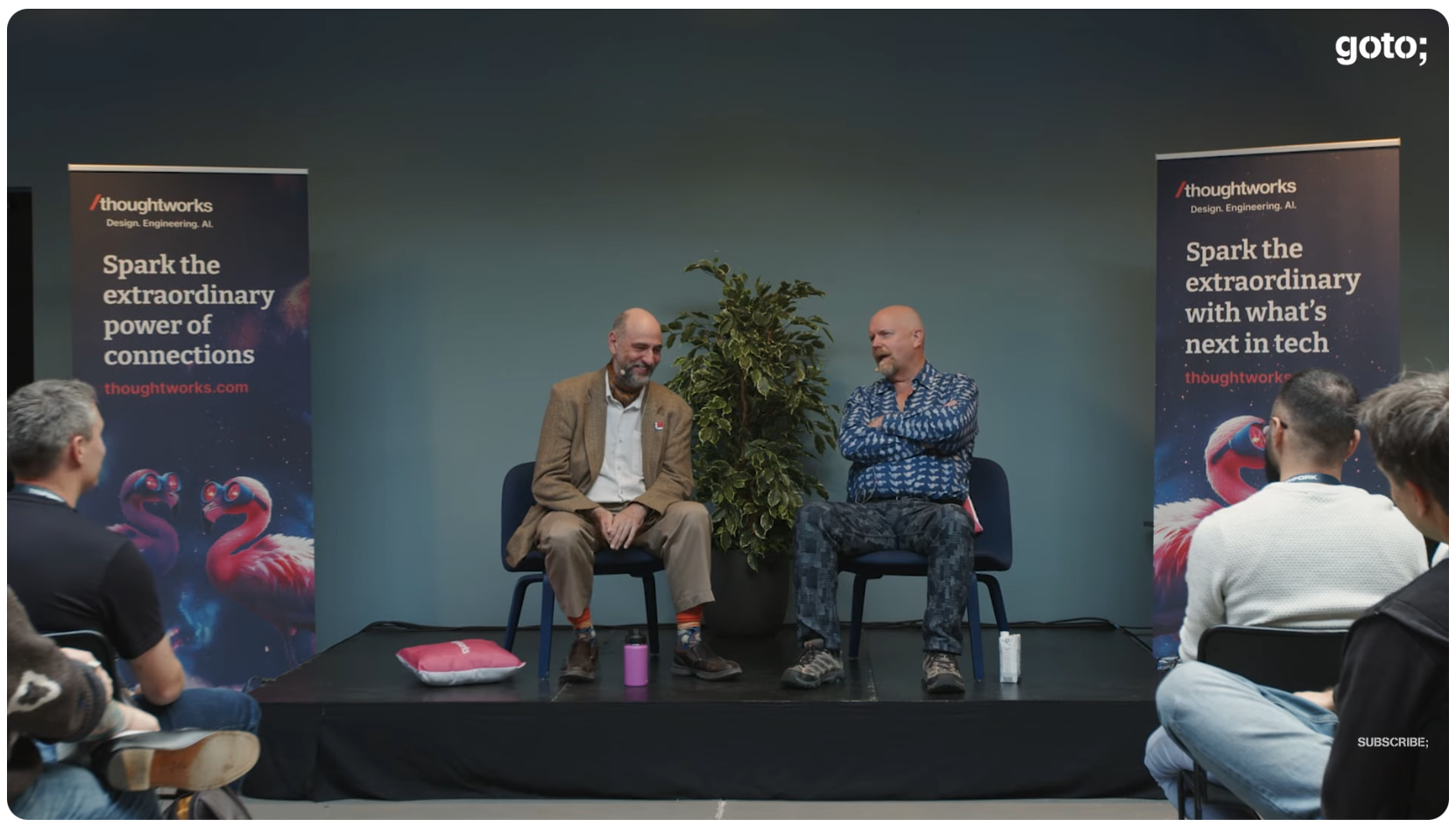
At the GOTO Conference in Copenhagen in 2025, Kent Beck and I spent some time on stage talking and answering questions from the audience - a format I refer to as “two old geezers on a park bench”. We talk about our experiences with LLM-augmented programming (at that point - October 2025), we show our frustration that things we’ve been…
Birgitta Böckeler finishes her post on sensors for coding agents by examining the role of a test suite as a regression sensor, focusing on the role mutation testing can play. more…
Vibe coding has significantly accelerated software prototyping but AI agents frequently recommend insecure configurations, creating security problems. Gautam Koul, Lucian Moss, Neil Drew-Lopez, and Daberechi Ruth Edeokoh share their experience while building applications for Thoughtworks's global marketing. They learned that to combat this we need to write a security context file to guide the AI, be cautious with AI permission…
21 May
Vibe coding is building a software application by prompting an LLM, telling it what to build, trying it out, prompting for changes - but without looking at any of the code that the LLM generates. This technique can be used by people without any knowledge of programming. However the resulting software often shows problems with maintainability, correctness, and security -…
14 May
Last week I spent a day at The Orchard Retreat, hosted by Mechanical Orchard. that brought together several people working in software development to talk about the profession’s future with the rise of agentic programming. The event was help under the Chatham House Rule, so I can’t attribute the comments and stories I heard. (If anyone recognizes themselves, and would…
When we need an LLM to perform a complex task, we often need to feed it a lot of context. Coming up with a design for a new feature requires descriptions of how we want the feature to appear to the user, guidelines on how it should be implemented, information on external systems to consult, and so on. All this…
12 May
Increasingly humans delegate writing code to agents. Will there even be source code in the future? To wrestle with this question, we have to understand what code is. Unmesh Joshi sees code as having two distinct but intertwined purposes: instructions to a machine and a conceptual model of the problem domain. He explores why it's vital to build a vocabulary…
5 May
Over the last couple of months Rahul Garg published a series of posts here on how to reduce the friction in AI-assisted programming. To make it easier to put these ideas into practice he’s now built an open-source framework to operationalize these patterns. AI coding assistants jump straight to code, silently make design decisions, forget constraints mid-conversation, and produce output…
In the early 1960s, Fred Brooks managed the development of IBM's System/360 computer systems. After it was done he penned his thoughts in the book The Mythical Man-Month which became one of the most influential books on software development after its publication in 1975. Reading it in 2026, we'll find some of it outdated, but it also retains many lessons…
29 Apr
Chris Parsons has updated his guide on using AI to code. This is his third update, what I like about it is that he gives a lot of concrete information about how he uses AI, with sufficient detail that we can learn from him. His advice also resonates with the better advice I’ve seen out there, so the article makes…
28 Apr
LLM programming assistants have demonstrated considerable value, but mostly with individual developers. The internal IT organization in Thoughtworks has been using them for their teams and have developed a method and workflow called Structured Prompt-Driven Development (SPDD). Wei Zhang and Jessie Jie Xia describe a simple example of this workflow with details in github. This workflow treats the prompts as…
21 Apr
Last week Thoughtworks released the 34th volume of our Technology Radar. This radar is our biannual survey of our experience of the technology scene, highlighting tools, techniques, platforms, and languages that we’ve used or otherwise caught our eye. This edition contains 118 blips, each briefly describing our impressions of one of these elements. As we would expect, the radar is…
14 Apr
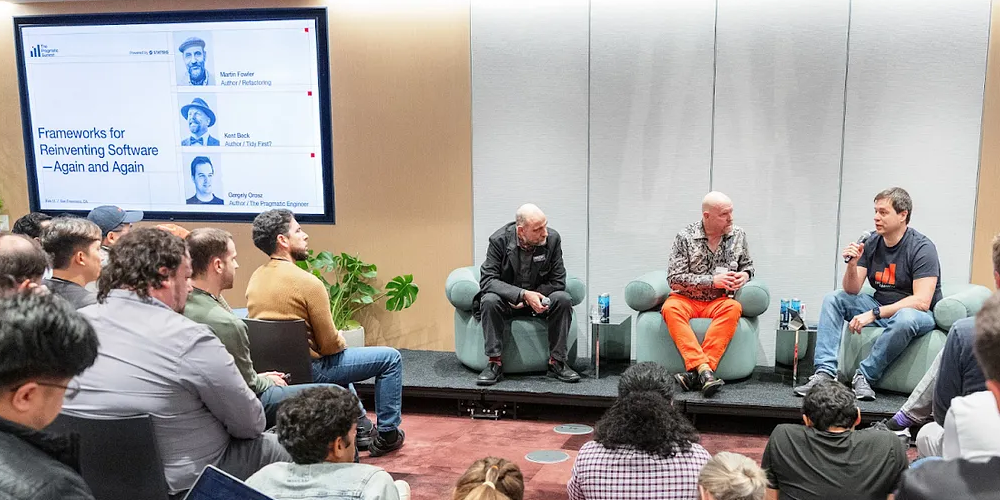
I attended the first Pragmatic Summit early this year, and while there host Gergely Orosz interviewed Kent Beck and myself on stage. The video runs for about half-an-hour. I always enjoy nattering with Kent like this, and Gergely pushed into some worthwhile topics. Given the timing, AI dominated the conversation - we compared it to earlier technology shifts, the experience…
11 Apr
Last night I saw Central Square Theater’s excellent production of Breaking the Code. It’s about Alan Turing, who made a monumental contribution to both my profession and the fate of free democracies. Well worth seeing if you’re in the Boston area this month.
9 Apr
I mostly link to written material here, but I’ve recently listened to two excellent podcasts that I can recommend. Anyone who regularly reads these fragments knows that I’m a big fan of Simon Willison, his (also very fragmentary) posts have earned a regular spot in my RSS reader. But the problem with fragments, however valuable, is that they don’t provide…
8 Apr
Rahul Garg finishes his series on reducing the friction in AI-Assisted Development. He proposes a structured feedback practice that harvests learnings from AI sessions and feeds them back into the team's shared artifacts, turning individual experience into collective improvement. more…
7 Apr
Modern hardware is remarkably fast, but software often fails to leverage it. Caer Sanders has found it valuable to guide their work with mechanical sympathy - the practice of creating software that is sympathetic to its underlying hardware. They distill this practice into everyday principles: predictable memory access, awareness of cache lines, single-writer, and natural batching. more…
2 Apr
As we see LLMs churn out scads of code, folks have increasingly turned to Cognitive Debt as a metaphor for capturing how a team can lose understanding of what a system does. Margaret-Anne Storey thinks a good way of thinking about these problems is to consider three layers of system health: Technical debt lives in code. It accumulates when implementation…
Last month Birgitta Böckeler wrote some initial thoughts about the recently developed notion of Harness Engineering. She's been researching and thinking more about this in the weeks since and has now written a thoughtful mental model for understanding harness engineering that we think will help people to drive coding agents more effectively. more…
31 Mar
AI coding assistants respond to whoever is prompting, and the quality of what they produce depends on how well the prompter articulates team standards. Rahul Garg proposes treating the instructions that govern AI interactions (generation, refactoring, security, review) as infrastructure: versioned, reviewed, and shared artifacts that encode tacit team knowledge into executable instructions, making quality consistent regardless of who is…
26 Mar
Anthropic carried a study, done by getting its model to interview some 80,000 users to understand their opinions about AI, what they hope from it, and what they fear. Two things stood out to me. It’s easy to assume there are AI optimists and AI pessimists, divided into separate camps. But what we actually found were people organized around what…
24 Mar
An Architecture Decision Record (ADR) is a short document that captures and explains a single decision relevant to a product or ecosystem. Documents should be short, just a couple of pages, and contain the decision, the context for making it, and significant ramifications. They should not be modified if the decision is changed, but linked to a superseding decision. As…
17 Mar
Conversations with AI are ephemeral, decisions made early lose attention as the conversation continues, and disappear entirely with a new session. Rahul Garg explains how Context Anchoring externalizes the decision context into a living document. more…
5 Mar
Naresh Jain has long been uncomfortable with software patents. But a direct experience of patent aggression, together with the practical constraints faced by startups, led him to resort to defensive patenting as as a shield in this asymmetric legal environment. more…
4 Mar
There's been much talk recently about how AI agents affect the workflow loops of software development. Kief Morris believes the answer is to focus on the goal of turning ideas into outcomes. The right place for us humans is to build and manage the working loop rather than either leaving the agents to it or micromanaging what they produce. more…
3 Mar
Rahul Garg continues his series of Patterns for Reducing Friction in AI-Assisted Development. This pattern describes a structured conversation that mirrors whiteboarding with a human pair: progressive levels of design alignment before any code, reducing cognitive load, and catching misunderstandings at the cheapest possible moment. more…
24 Feb
Rahul Garg has observed a frustration loop when working with AI coding assistants - lots of code generated, but needs lots of fixing. He's noticed five patterns that help improve the interaction with the LLM, and describes the first of these: priming the LLM with knowledge about the codebase and preferred coding patterns. more…