Way back in Dec 2015, @maxogden wrote a nice guide on stabilizing your own video with ffmpeg. I return to it on occasion and have updated my gist comment to offer some updated commands. Since enough has changed regarding installation and use, I figure a new, spiffy, and working guide deserves a non-gist home. Presenting the 2021-era guide to pretty…
Paul Irish
https://www.paulirish.com/ · 20 posts · history since 2011 · active
30 Apr 2021
28 Feb 2018
I’ve published a few articles on Medium that may interest the reader here: requestAnimationFrame Scheduling For Nerds Understand how rAF callbacks are scheduled and why its very reasonable to have multiple callbacks execute within the same frame. Debugging Node.js with Chrome DevTools The canonical guide to using the Chrome DevTools UI for debugging Node.js. It definitely beats console.log. ;) Aside…
27 Mar 2015
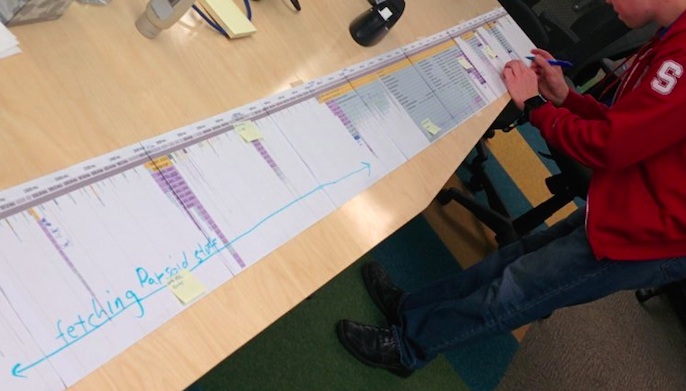
Recently, I’ve spent some time recently profiling real-world mobile websites. Using the 1000/100/6 performance model1, and spelunking deep into each app, the findings have been fascinating. I’ve written up case study documents for each, incorporating all the findings: Illustrated diagnoses for the poor performance What actions the developer should take How Chrome’s tooling should improve Questions and insights for the…
28 Feb 2013

Feb 2015: A lot’s happened since I wrote this post two years ago. Chrome forked WebKit and started Blink, Opera adopted Chromium, and node-webkit became nw.js. This post describes a complexity of defining WebKit that doesn’t exist much anymore; with Chrome’s departure the WebKit world is more simple and clear. WebKit is deployed through iOS Safari and Mac Safari, and…
20 Dec 2012
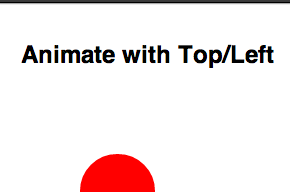
Update (2016): The more canonical writeup of this technique is at High Performance Animations - HTML5 Rocks. TL;DR: Only transform & opacity; never top/left! In modern days we have two primary options for moving an element across the screen: using CSS 2D transforms and translate() using position:absolute and top/left Chris Coyier was asked why you should use translate. Go read…
2 Nov 2012

If you do front-end web development and already use Chrome as your development browser, I encourage you to use Chrome Canary. A new Chrome Canary build is available daily (we cut at 2am PST and take the best of last 40 revisions, to be specific). Running fresh builds gives you great goodies to look forward: Chrome DevTools features $_ (for…
29 Oct 2012
The great folks at Treehouse sat down with me for 30 minutes to talk about frontend development, my background, HTML5 Boilerplate and tooling. A few highlights: 3:40 Where’d I grow up? What was I into? (Also, the supercool IE4 DHTML event I went to!) 14:45 What’s my favorite feature inside the HTML5 Boilerplate? 18:34 Will web development even out where…
8 Oct 2012
I absolutely love developing for the clientside of the web. Delivering the actual interactions and UI that all users feel is an absolutely gratifying experience. However… it’s not a piece of cake to develop for all desktop browsers, mobile browsers, and all the device/OS combinations within. It’s hard to track down accurate info, but hey we get by with an…
24 Sept 2012
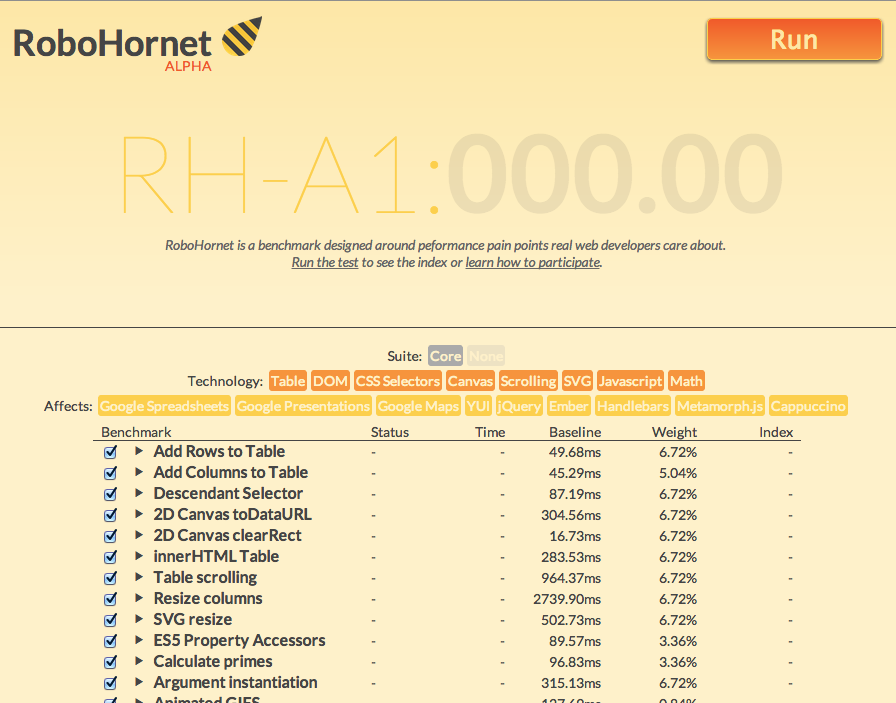
The past few years’ browser focus on speed has been great for us and our users. We’ve seen a huge and dramatic performance boost on benchmarks like Sunspider, Kraken, and Octane. But, these benchmarks, often crafted by JavaScript VM engineers, test raw JavaScript performance, which is rarely the bottleneck we have in our apps. These days, our performance bottlenecks are…
13 Sept 2012
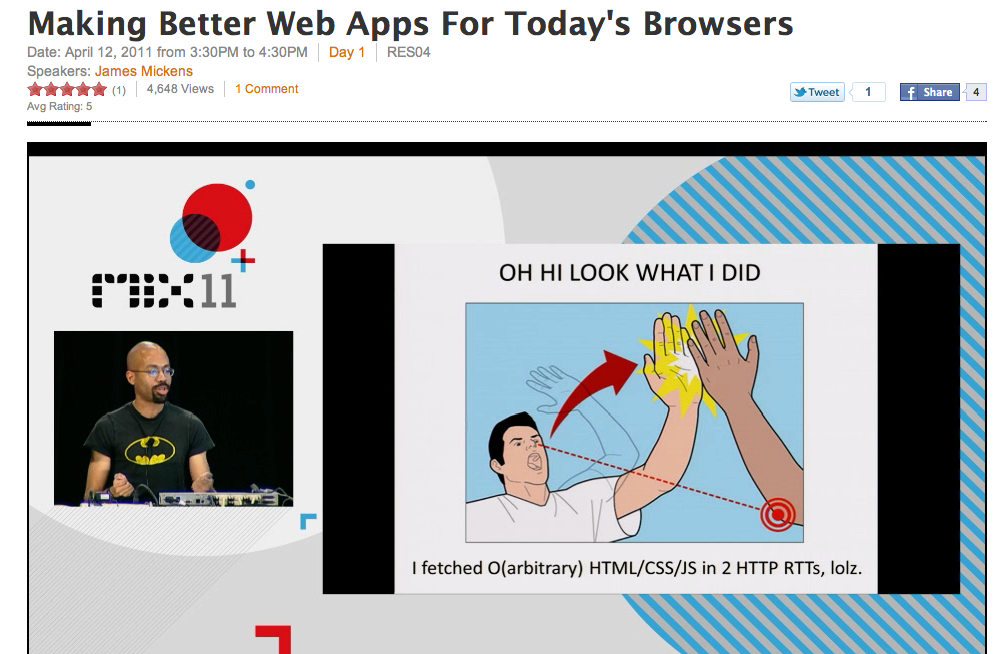
University-level education has never really touched too directly on what we do as frontend developers. I know I was self-taught in the ways of the browser, as were all of my friends. Luckily the sort of webapp work we do these days is quite sophisticated so those CS graduates bring much of the great ideas to the JavaScript community. (Alex…
17 Aug 2012
One of the good things about having the eyeballs of many people is that you now have the ability to throw other people into the limelight that completely deserve to be in it. Divya Manian and I have been, for a while now, putting together a list of people in the front-end development community who, in our opinion, could use…
29 Jun 2012
Every month, WebKit, Firefox and Opera are shipping incredible features; IE10 is also going to settle up and even out those HTML5 Test scores (plus some features they may debut, like Grid Layout!). But while these features are becoming available in some browsers, most of us can’t use them because we have a sizable audience who have been left behind…
1 Jun 2012

Jacob Thornton has an inspiring slide deck on accessibility that brings to fore some of the concerns that web developers have with implementing features around accessibility. For a very long time, developers have been told about making websites ‘accessible’. Like it is a faucet that should be turned on or off. Till Victor Tsaran’s demonstration of using a screenreader (which…
1 May 2012
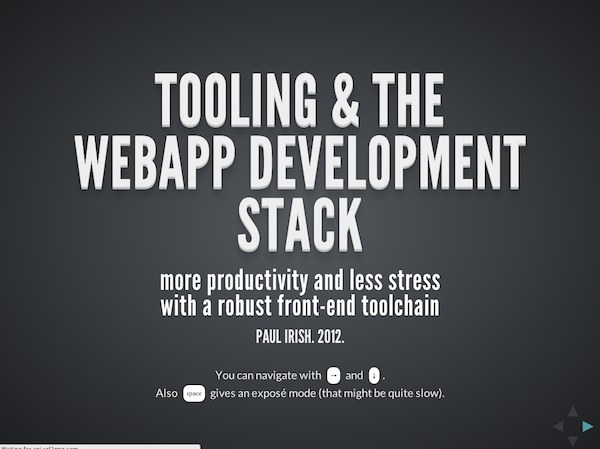
One of the things I recognize at Google is how productive developers surround themselves with powerful tools for iterative development and debugging. For us front-end developers, the ecosystem of tools has exploded in the past two years, as we have a lot more software and libraries beyond Firebug and jQuery to help us build webapps. In the talk below I…
5 Mar 2012

or… The premise of prefixes makes unrealistic demands on how developers maintain sites There’s a lot of conversation about making prefixes work (by changing policy), but I believe they already are at odds with the developer workflow. In this proposal I hope to show that: prefixes are not developer-friendly recent features would have been in a much better state without…
1 Feb 2012
One of my least favorite parts about layout with CSS is the relationship of width and padding. You’re busy defining widths to match your grid or general column proportions, then down the line you start to add in text, which necessitates defining padding for those boxes. And ‘lo and behold, you now are subtracting pixels from your original width so…
4 Dec 2011
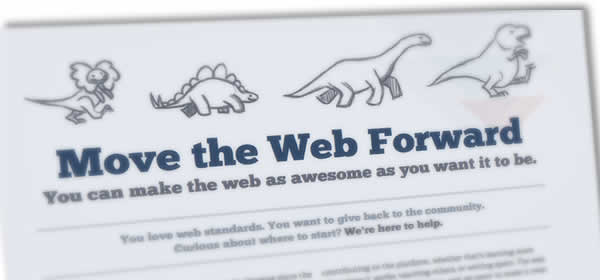
This Wednesday, me and a ragtag team of like-minded developers launched Move the Web Forward, an initiative to direct people’s passions into productive efforts that assist not only the web community but the entire web platform. People often feel the need to “give back”, but when it comes to contributing it’s a challenge to find the right place. This is…
22 Nov 2011
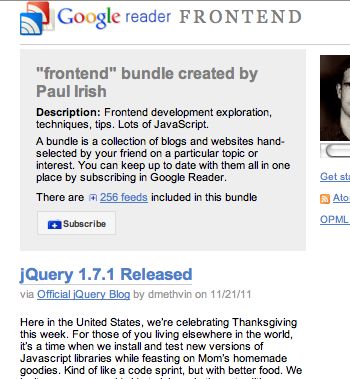
While a lot of conversation has moved to twitter and G+, hugely useful information is still published regularly to blogs. I’ve shared collections of frontend development feeds twice before. Now I’m back, but with three choices: Download this: frontend-feeds.opml most important site that has no feed: webplatformdaily.org. It’s the best thing. (2013.09.12: It has a feed now! Added) 2013.09.12: The…
21 Nov 2011
Just gave this talk at W3Conf about some of the innerworkings of HTML5. Lots of did-you-know and cool insight into how browsers work. 37 minutes long, The Primitives of the HTML5 Foundation - Slides I do discuss optional start and end tags as well as not quoting your attributes. I concede that these ideas scare the shit out of people.…
14 Nov 2011
Divya Manian kicked off a good bout of discussion of HTML semantics with her post Our pointless pursuit of semantic value. It called into question the amount of time we spend on identifying the Right and Best ways of marking up our content while highlighting details of some of the consumers of semantics like assistive technology (AT). Jeremy Keith responded…